Project overview#
The “Big Two” model of personality has stronger evidence for cross-cultural replicability than any other lexically-based model of personality. Many individual lexical studies across languages and cultural contexts have reproduced this Big Two structure, which captures (a) Communion/Social Self-regulation (the internalization versus resistance to the normative code’s of one’s society–with components of warmth, morality, respect, and industriousness), and (b) Agency/Dynamism (which reflects approach versus avoidant tendencies, with components of competence, confidence, fearlessness, positive mood, and sociability). The present work further developed the theoretical model of the Big Two and established the validity of a Big Two personality assessment instrument.
Method#
The initial pool of 55 items (collected from or developed based on 11 global lexical studies) was first reduced to a subset of 45 items that were most consistently understood across English-speaking contexts. All items begin with the stem “I tend to be…” and are followed by a trait-descriptive adjective like “lively” or “polite”, and participants respond with an answer option from 1 (very inaccurate) to 6 (very accurate).
Items retained in the subset of 45 were selected based on…
The frequency of use of the trait-descriptive adjective in World English corpora
Familiarity ratings and exploratory factor analysis results among Africa Long Life Study participants (N = 2,958 18 year old participants from Namibia, Kenya, and South Africa)
Distribution test statistics, exploratory factor analysis results, and test–retest reliability in SAPA project data from 13 diverse English-speaking countries (N = 61,760).
Next, we examined the validity of the 45-item Cross-Cultural Big Two Inventory (CCBTI) by…
Exploring relationships with external criteria in the Africa Long Life Study samples
Comparing the CCBTI and other Two-Factor models across sub-fields of psychology (e.g., measures of Stability and Plasticity) and exploring relationships with other personality traits and demographic characteristics in the SAPA project sample.
Results#
Here, I focus on findings I contributed to this project from the SAPA project dataset, which tell us about the dimensionality, reliability, and construct validity of the CCBTI scales. If you’re interested in reading more about the earlier steps in the validation process, we discuss all details in the published manuscript, and you can read more about the Africa Long Life Study (ALLS) lead by Dr. Amber Gayle Thalmayer and colleagues here.
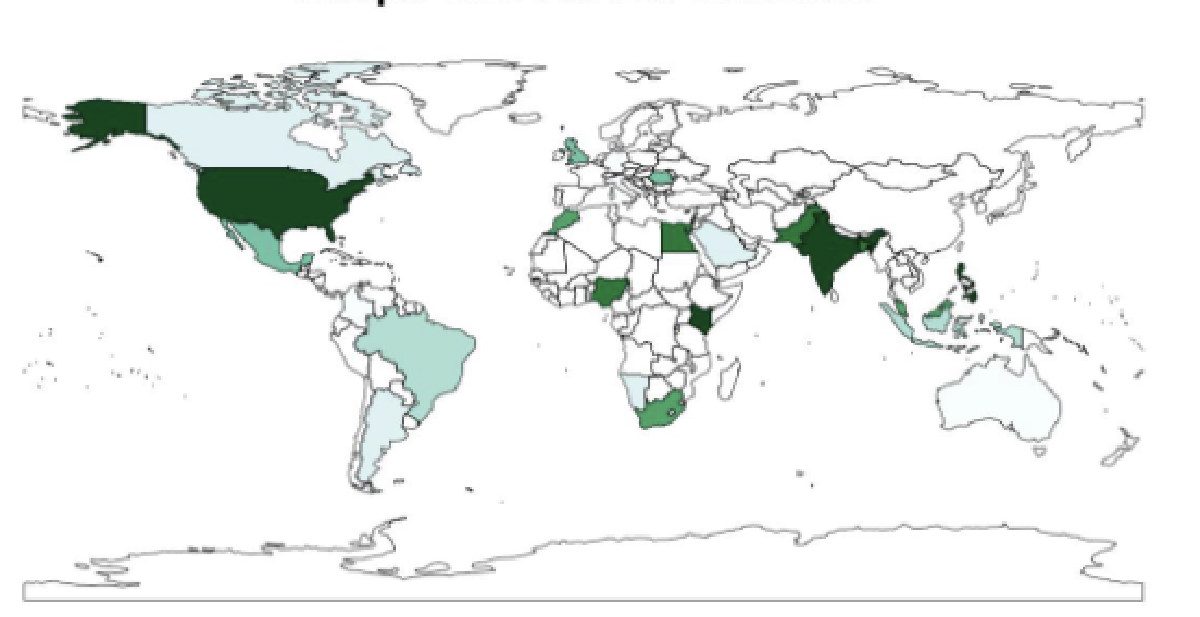
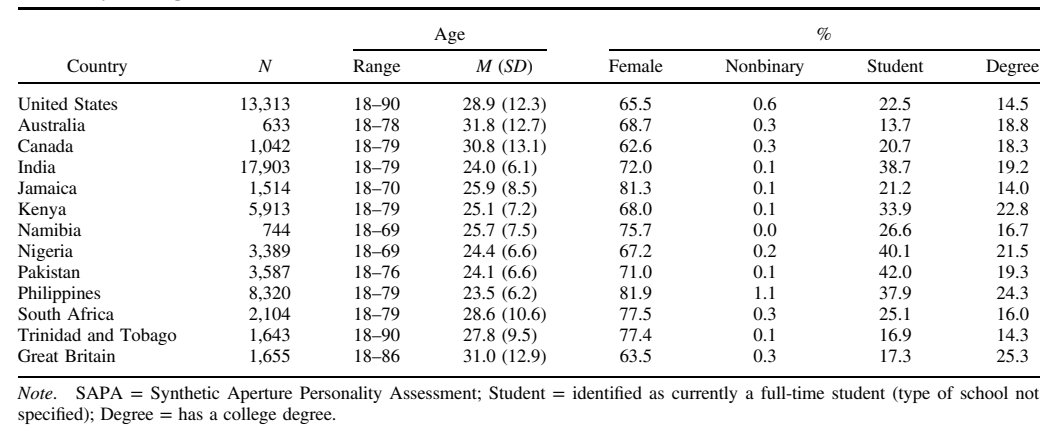
The SAPA project sample included 61,760 participants who ranged in age from 18 to 90 years old (M = 25.8, SD = 9.0) from 13 geographically and culturally diverse nations. Sample characteristics for each nation included are shown in the table below.
SAPA Project Sample Characteristics
Psychometric Properties#
Overall, findings indicate that the Agency and Communion sub-scales demonstrate strong psychmetric properties.Internal consistency among items was strong for both Communion/SSR (α = .87) and Agency/Dynamism (α = .91), and Omega Hierarchical values indicated moderate unidimensionality for both scales (ωh Communion/SSR = .63; ωh Agency/Dynamism = .57).
This suggests that the CCBTI measures two cohesive, and relatively unidimensional psychological constructs.
Construct Validity#
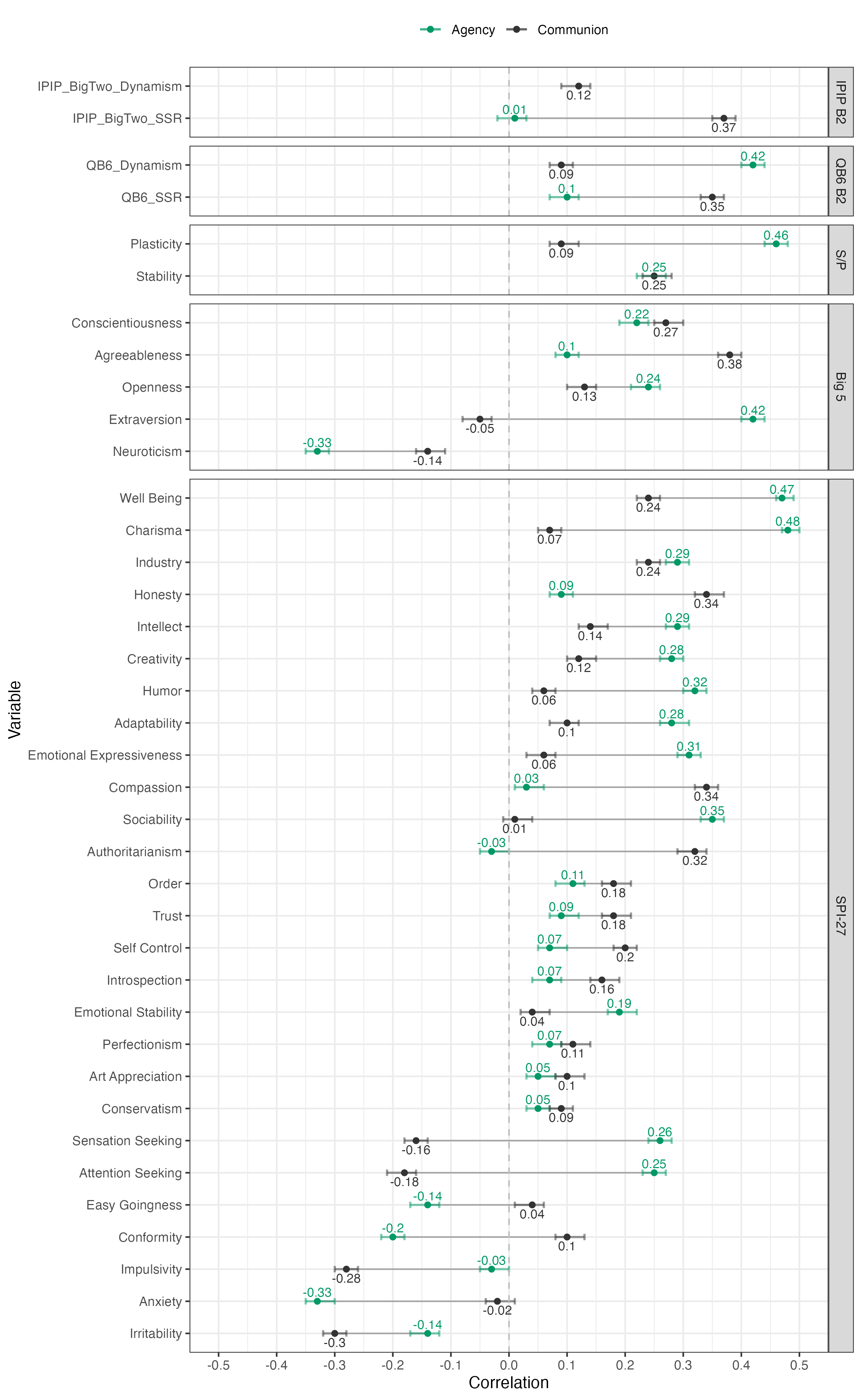
Next, the construct validity of the CCBTI subscales was examined to determine whether they measure the individual differences they were designed to assess. This involved exploring relationships with previous measures of the “Big Two” (or similar measures), and with personality constructs from other frameworks such as the Big Five traits and the 27 traits from SAPA Personality Inventory.
With the Big Five, correlations were largely as expected with Communion/SSR moderately positively associated with Agreeableness and Conscientiousness and Agency/Dynamism with Extraversion, Openness, and (negatively) Neuroticism. The SPI-27 scales that associated most strongly with Communion/SSR were Compassion, Honesty, and Authoritarianism versus Irritability and Impulsivity. The strongest associations with Agency/Dynamism were for Charisma, Well-Being, Humor, and Sociability versus Anxiety.
Relationships with other personality scales:
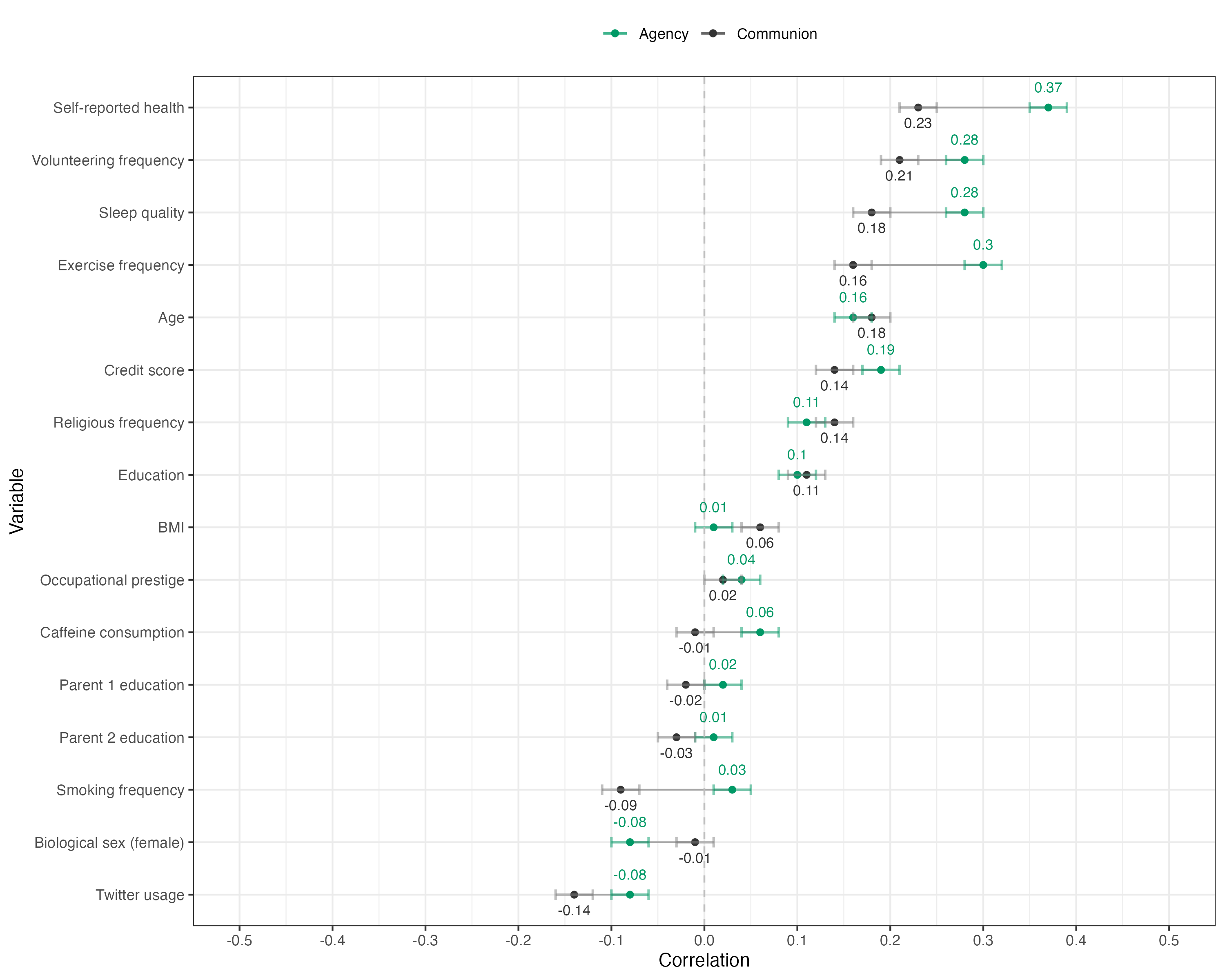
The only substantial zero-order associations of the CCB2I scales with sociodemographic and behavioral variables were for Agency/Dynamism with health and exercise frequency; these were also positive but low for Communion/SSR. In all other cases correlations were in the expected direction but small in magnitude, with the exception of Twitter usage, which had a small negative correlation with Agency/Dynamism. Agency/Dynamism had a slightly higher correlation with many health variables than did Communion/SSR.
Relationships with behavioral and demographic outcomes:
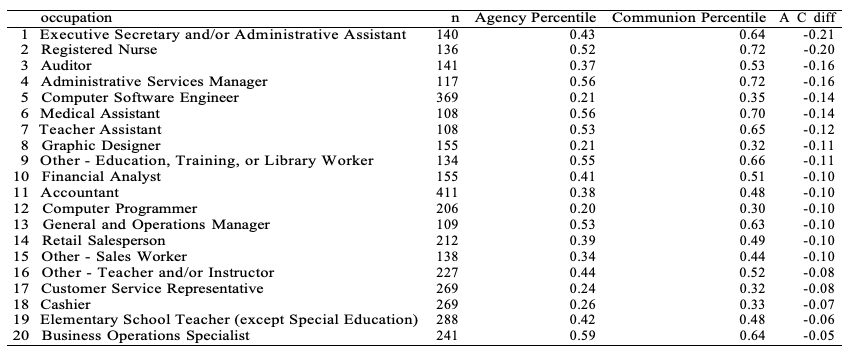
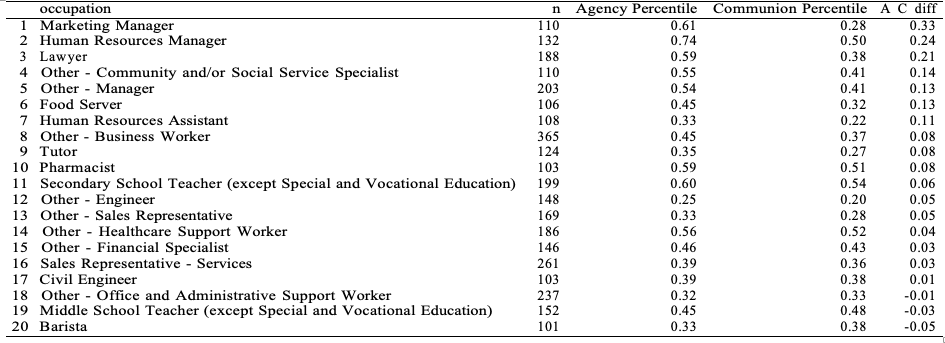
Findings also revealed which occupations were most differentially associated with Communion/SSR and Dynamism/Agency.
Occupations with the highest Communion to Agency percentile difference
The occupations distinguished more by high Communion relative to Agency levels included Executive Secretary/Administrative Assistant, Registered Nurse, Administrative Services Manager, and Medical Assistant. Many of these could be considered “service” or “helping” professions, which generally demand more of a focus on the physical or mental well being of others (i.e., higher levels of Communion).
However, several occupations here––such as Auditor, Computer Software Engineer, accountant, computer programmer––appear to rank highly on the Communion to Agency percentile due to lower average levels of both. Entrance into and success in these occupations likely depend more on interests and specific cognitive skills (e.g., mathematical or spatial ability) than on the temperament-related behaviors and skills assessed by the CCBTI.
Occupations with the highest Agency to Communion percentile difference
Alternatively, occupations distinguished by high Agency relative to Communion levels included Marketing Manager, Human Resources Manager, Lawyer, Community/Social Service Specialist, Manager, and Food Server. Entrance into and success in many of these occupations (e.g., Lawyer, Managerial roles) likely demand higher levels of sociability, confidence, and boldness.
However, similar to findings for occupations with higher relative Communion levels, some of those with higher relative Agency levels may not demand higher levels of either Big Two construct (e.g., pharmacist, financial specialist). Instead, they might require strengths captured by other individual differences, such as cognitive skills, specific knowledge and expertise, or strong interest.
Conclusions and impact#
This work established an initial personality assessment built using a more culturally inclusive development process. It provides researchers with a foundation for investigating personality across diverse populations while helping address the risk of treating culturally specific assumptions as universal psychological patterns.